Stelvio Pass by Motorcycle: Mastering All 48 Alpine Hairpins – Map & GPX
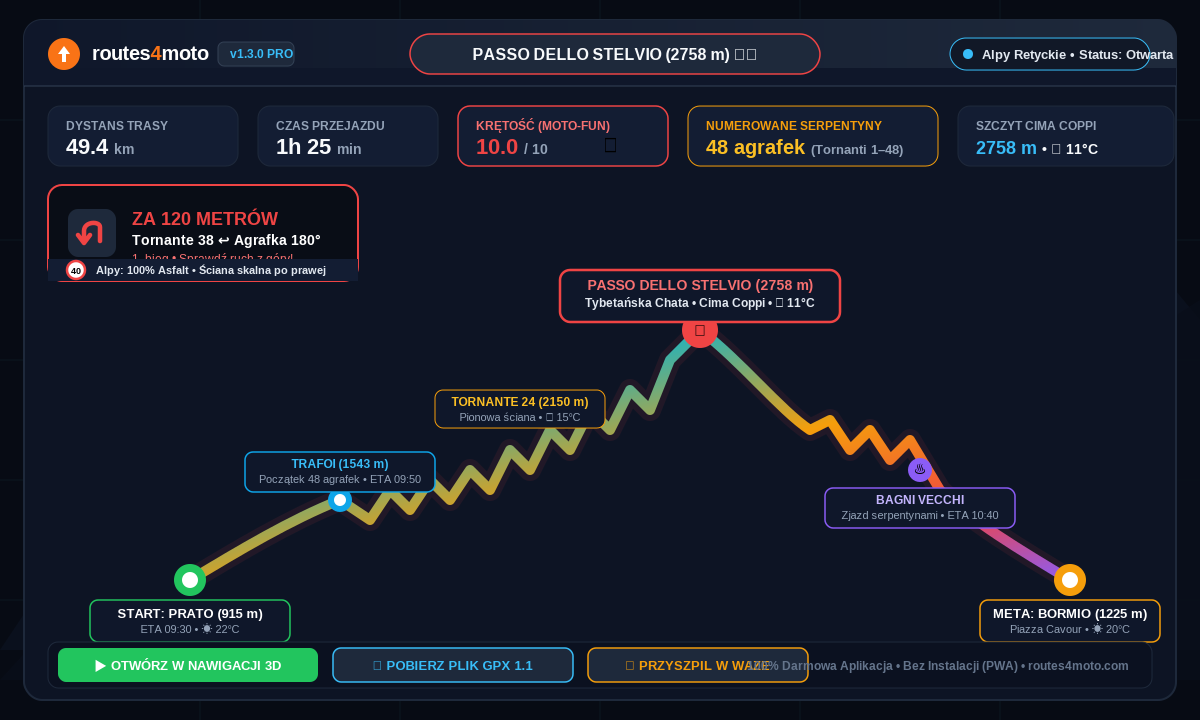
Crowning the Rhaetian Alps at 2,758 meters above sea level, Passo dello Stelvio is the highest paved mountain pass in Italy and the second highest across the entire Alpine arc. Engineered in the 1820s to link South Tyrol with Lombardy, highway SS38 climbs more than 1,840 vertical meters within a compact 49-kilometer traverse. For riders across Europe, scaling its stacked stone switchbacks is an essential rite of passage.
Tarmac quality and cornering technique for 48 tight switchbacks
The northeastern ramp rising out of Prato allo Stelvio (915 m) is the stuff of motorcycling legend: forty-eight numbered hairpins (tornanti) carved into sheer rock at gradients reaching 14%. While maintenance crews patch frost heave every spring, the inside apex of right-hand uphill hairpins remains steep, ultra-tight, and partially obscured by historic stone retaining walls.
On a loaded adventure bike or heavyweight tourer, smooth low-speed technique makes every difference: set up wide in your own lane without crossing the centerline, stay committed in first gear, keep positive drive in the friction zone, and settle the chassis exclusively with gentle rear-brake drag. Never fixate on your front fender—turn your chin high toward the uphill exit while scanning early for descending motorhomes and cyclists. Beyond the summit, the southwestern descent into Bormio rewards you with 36 broader, faster corners, rock-cut galleries, and flowing alpine tarmac.
Best panoramic viewpoints and saddle stops
Give yourself plenty of time along the climb and descent to soak in the glacier drama of Stelvio National Park:
- Trafoi Valley (1,543 m): Your first jaw-dropping sightline straight up to the hanging icefalls of Mount Ortler (3,905 m) framed by spruce forests.
- Franzenshöhe (2,189 m): A mid-climb pullout offering an extraordinary vantage point down the lower staircase of switchbacks and up toward the summit ridge.
- Tibet Hütte Terrace (2,758 m): Perched slightly above the main pass saddle, delivering the world-famous postcard view over the stacked wall of 48 hairpins.
- Umbrail Pass Junction (2,501 m): Just below the crest on the Lombard side, immaculate Swiss tarmac branches into Val Müstair for an unforgettable cross-border loop.
Biker-friendly stays and legendary summit food
Both valley gateways cater brilliantly to touring motorcyclists looking for secure overnight parking and hearty alpine fare:
- Hotel Bella Vista (Trafoi) & Prato allo Stelvio inns: Sleep at the foot of the northeast wall so you can attack the 48 hairpins at 07:30 on empty tarmac.
- Bormio Moto-Hotels: Enjoy locked underground garages, wash stations, drying rooms, and an evening soak in Bormio's natural thermal baths.
- Summit Sausage Stalls & Tibet Hütte: Celebrate reaching Cima Coppi with Richard Johan's famous grilled bratwurst topped with warm sauerkraut in a crusty roll, followed by rich Italian espresso overlooking the glacier.
- Valtellina Trattorias in Bormio: Refuel after dusk with handmade buckwheat pizzoccheri pasta melted with Casera cheese and cured bresaola.
Practical tips: summit ETA weather, seasonal closures, and fuel
Crossing nearly 2,800 meters demands respect for rapidly shifting high-alpine weather and calendar events:
- Temperature drop and ETA weather: A sunny +26°C afternoon in Prato valley routinely translates to +2°C, biting wind, or sudden sleet at the summit. Check the dynamic ETA weather forecast in routes4moto for your exact summit arrival hour and carry thermal mid-layers and windproof gloves.
- Seasonal window and road closures: Stelvio typically opens in late May or early June and closes for winter in mid-to-late October. Watch for one-day motorized traffic closures during Giro d'Italia stages or Stelvio Bike Day in late August/early September.
- Tolls and fuel stops: Riding SS38 over Stelvio Pass is completely toll-free. Top up your tank in Prato allo Stelvio or Bormio—or detour via Passo del Foscagno into duty-free Livigno for cheap alpine petrol.